
Tư vấn kỹ thuật
Nguyên Lý Cơ Bản Về Phòng Chống Cháy Nổ – Ngăn Chặn Vụ Nổ Trước Khi Bắt Đầu
Trong ngành công nghiệp hóa chất và hóa dầu, khai thác dầu thô và khí tự nhiên, khai khoáng, công nghiệp thực phẩm, chế tạo máy và xây dựng nhà máy công nghiệp, cũng như trong nhiều ngành công nghiệp khác, các chất khí, hơi hoặc sương mù dễ cháy có thể thoát ra ngoài trong quá trình sản xuất, chế biến, vận chuyển và lưu trữ – đồng thời các quy trình khác có thể phát sinh bụi dễ cháy. Những chất này có thể tạo thành môi trường khí quyển nổ (explosive atmosphere) nếu hòa trộn với oxy trong không khí. Nếu môi trường này bị kích cháy, nó có thể gây ra các vụ nổ dẫn đến thương tích nghiêm trọng cho con người và/hoặc thiệt hại lớn về tài sản.
Vụ nổ là gì? (What is an explosion?)
Vụ nổ là phản ứng hóa học đột ngột của một chất dễ cháy kèm theo sự giải phóng năng lượng cực lớn. Không cần quá nhiều yếu tố để tạo ra một “vụ nổ lớn” (big bang) – chỉ cần 3 yếu tố đồng thời xuất hiện:
- Một chất dễ cháy (combustible substance) ở dạng khí (gas), hơi (vapour), sương mù (mist) hoặc bụi (dust).
- Chất dễ cháy hiện diện kết hợp với oxy (oxygen), hoặc không khí có chứa oxy. Sự kết hợp này dẫn đến việc hình thành một môi trường khí quyển nổ.
- Cuối cùng, một nguồn đánh lửa (source of ignition) khiến môi trường khí quyển nổ này bốc cháy.
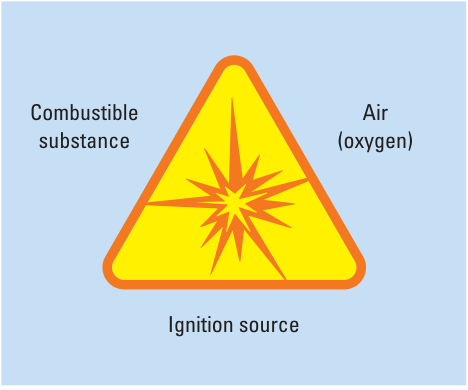
Kỹ thuật phòng chống cháy nổ xoay quanh việc ngăn chặn các vụ nổ này. Để làm được điều đó, trước hết bạn cần ngăn chặn sự hình thành của môi trường khí quyển nổ.
Môi trường khí quyển nổ (Explosive atmosphere)
Môi trường khí quyển nổ là hỗn hợp của không khí và các chất dễ cháy trong điều kiện khí quyển, mà tại đó sau khi xảy ra đánh lửa, quá trình cháy sẽ lan truyền ra toàn bộ phần hỗn hợp chưa cháy. Điều kiện khí quyển tiêu chuẩn bao gồm:
- Nhiệt độ môi trường từ -20 °C đến +60 °C
- Dải áp suất từ 0,8 đến 1,1 bar
- Hàm lượng oxy trong không khí ở mức 21%
Các khu vực có sự hiện diện của môi trường khí quyển nổ được coi là khu vực nguy hiểm cháy nổ (hazardous areas).
Ngăn chặn vụ nổ trước khi nó bắt đầu (Stop a big bang before it starts)
Các biện pháp bảo vệ phải được triển khai nhằm ngăn ngừa vụ nổ xảy ra. Trước tiên và quan trọng nhất, phải ngăn chặn sự hình thành của môi trường khí quyển nổ (phòng nổ sơ cấp – primary explosion protection). Do đó, cần tiến hành kiểm tra để xác định xem liệu chất nguy hiểm có thể được thay thế bằng một chất khác không gây nguy cơ nổ hoặc giảm thiểu khả năng gây nổ hay không. Các phương pháp thường được sử dụng bao gồm thông gió (ventilation) – việc đảm bảo phòng/nhà xưởng được thông gió tốt có thể làm giảm đáng kể nồng độ của các chất dễ cháy.
Hơn nữa, có thể xem xét các biện pháp giới hạn nồng độ ngay trong quy trình công nghệ. Việc bổ sung các khí trơ đệm (buffer/inert gases) như nitơ (nitrogen) hoặc carbon dioxide (CO₂) cho phép làm giảm nồng độ oxy trong quy trình, từ đó ngăn chặn sự hình thành môi trường khí quyển nổ.
Nếu không thể loại bỏ hoàn toàn hoặc chỉ loại bỏ được một phần nguy cơ nổ bằng các biện pháp phòng nổ sơ cấp, thì bắt buộc phải áp dụng các biện pháp phòng ngừa để ngăn chặn sự đánh lửa (phòng nổ thứ cấp – secondary explosion protection). Nhờ đó, không có nguồn đánh lửa hữu hiệu nào được phép phát sinh. Tuy nhiên, trong một số trường hợp, đây vẫn chưa phải là giải pháp triệt để vì một số nguồn đánh lửa không thể loại bỏ hoàn toàn. Trong những trường hợp này, phải triển khai các biện pháp nhằm giới hạn tác động nguy hiểm của vụ nổ ở mức không đáng kể. Phòng nổ cấp ba (“tertiary”) hay phòng nổ kết cấu (“constructive” explosion protection) bao gồm việc sử dụng kết cấu chịu áp lực nổ (explosion-proof structures), thiết bị xả áp nổ (explosion pressure relief), hệ thống dập nổ (explosion suppression) và van/hàng rào ngăn lửa nổ (explosion barriers).
Phân chia khu vực nguy hiểm thành các vùng (Dividing hazardous areas into zones)
Tại các khu vực nguy hiểm, tần suất và thời gian xuất hiện của môi trường khí quyển nổ có thể khác nhau, đó là lý do các khu vực này được phân loại thành các vùng (Zones) khác nhau. Việc phân vùng này phản ánh xác suất xuất hiện của môi trường khí quyển nổ, giúp bạn dễ dàng lựa chọn thiết bị tương ứng và thiết kế hệ thống điện phù hợp.
| Môi chất | Vùng (Zone) | Định nghĩa & Mức độ xuất hiện môi trường nổ |
|---|---|---|
| Khí, hơi, sương mù (Gas) |
Zone 0 | Khu vực mà môi trường khí quyển nổ nguy hiểm (hỗn hợp của không khí và khí, hơi hoặc sương mù dễ cháy) hiện diện liên tục, trong thời gian dài hoặc thường xuyên. |
| Zone 1 | Khu vực mà môi trường khí quyển nổ nguy hiểm (hỗn hợp của không khí và khí, hơi hoặc sương mù dễ cháy) đôi khi xuất hiện trong điều kiện vận hành bình thường. | |
| Zone 2 | Khu vực mà môi trường khí quyển nổ nguy hiểm (hỗn hợp của không khí và khí, hơi hoặc sương mù dễ cháy) thường không hiện diện trong điều kiện vận hành bình thường, nhưng nếu có xảy ra thì rất hiếm và chỉ tồn tại trong một khoảng thời gian ngắn. | |
| Bụi cháy (Dust / Staub) |
Zone 20 | Khu vực mà môi trường khí quyển nổ nguy hiểm ở dạng đám mây bụi dễ cháy trong không khí hiện diện liên tục, trong thời gian dài hoặc thường xuyên. |
| Zone 21 | Khu vực mà môi trường khí quyển nổ nguy hiểm ở dạng đám mây chứa bụi dễ cháy trong không khí có khả năng xuất hiện trong điều kiện vận hành bình thường. | |
| Zone 22 | Khu vực mà môi trường khí quyển nổ nguy hiểm ở dạng đám mây chứa bụi dễ cháy trong không khí thường không hiện diện trong điều kiện vận hành bình thường, hoặc nếu có thì chỉ tồn tại trong một khoảng thời gian ngắn. |
Phân loại thiết bị theo hạng mục (Category) và mức bảo vệ thiết bị (EPL)
Các yêu cầu an toàn khác nhau đối với thiết bị sử dụng phụ thuộc vào xác suất xuất hiện của môi trường khí quyển nổ. Thiết bị sử dụng trong Zone 0 hoặc Zone 20 phải tương ứng với hạng mục thiết bị (device category) 1G hoặc 1D và có mức bảo vệ thiết bị (Equipment Protection Level – EPL) là Ga hoặc Da. Thiết bị thuộc hạng mục 2G hoặc 2D với mức bảo vệ EPL Gb hoặc Db được phép sử dụng trong Zone 1 hoặc Zone 21. Thiết bị thuộc hạng mục 3G hoặc 3D với EPL Gc hoặc Dc phù hợp cho Zone 2 hoặc Zone 22.
| Môi trường | Zone | Thời gian hiện diện của môi trường khí quyển nổ | Hạng mục thiết bị (ATEX Category) | Mức bảo vệ thiết bị (EPL) |
|---|---|---|---|---|
| Khí, hơi, sương mù (Gases, vapours, mist) |
0 | Liên tục, kéo dài, thường trực (Continuous, over long periods, permanent) | 1G | Ga |
| 1 | Thỉnh thoảng (Occasionally) | 2G | Gb | |
| 2 | Thường không có, hoặc chỉ trong thời gian ngắn (Normally not present, or only for short times) | 3G | Gc | |
| Bụi cháy (Dusts) |
20 | Liên tục, kéo dài, thường trực (Continuous, over long periods, permanent) | 1D | Da |
| 21 | Thỉnh thoảng (Occasionally) | 2D | Db | |
| 22 | Thường không có, hoặc chỉ trong thời gian ngắn (Normally not present, or only for short times) | 3D | Dc |
Phân chia thành các nhóm nổ (Explosion groups) và cấp nhiệt độ (Temperature classes)
Ngoài ra, thiết bị còn được chia thành các nhóm tùy thuộc vào loại môi chất mà chúng được thiết kế để làm việc:
- Nhóm II (Group II) – Thiết bị cho khu vực nguy hiểm nổ khí (Devices for gas hazardous areas):
Được phân loại chi tiết hơn theo đặc tính của môi trường khí quyển nổ mà chúng phù hợp: IIA (khí điển hình: propane), IIB (khí điển hình: ethylene) và IIC (khí điển hình: hydro / hydrogen). - Nhóm III (Group III) – Thiết bị cho khu vực nguy hiểm nổ bụi (Devices for dust hazardous areas):
Tùy thuộc vào loại bụi, thiết bị phải đáp ứng các tiêu chí cho IIIA (xơ sợi dễ cháy – combustible lint), IIIB (bụi không dẫn điện – non-conductive dust) và IIIC (bụi dẫn điện – conductive dust).
Hơn nữa, thiết bị chỉ được phép vận hành trong khu vực nguy hiểm nếu nhiệt độ bề mặt tối đa (maximum surface temperature) của nó thấp hơn nhiệt độ tự bốc cháy (ignition temperature) của hỗn hợp nổ xung quanh. Vì mục đích này, các cấp nhiệt độ từ T1 đến T6 được quy định. Về mặt này, nhiệt độ môi trường tối đa cho phép cũng phải được tính đến vì nó ảnh hưởng trực tiếp đến nhiệt độ của thiết bị.
| Nhiệt độ bề mặt tối đa của thiết bị (°C) | Nhiệt độ tự bốc cháy của khí và hơi (°C) | Cấp nhiệt độ (Temperature class) |
|---|---|---|
| 450 | > 450 | T1 |
| 300 | > 300 đến 450 | T2 |
| 200 | > 200 đến 300 | T3 |
| 135 | > 135 đến 200 | T4 |
| 100 | > 100 đến 135 | T5 |
| 85 | > 85 đến 100 | T6 |
Bụi dễ cháy không được chia thành các cấp nhiệt độ T1–T6. Nhiệt độ bốc cháy của đám mây bụi phải được so sánh trực tiếp với nhiệt độ bề mặt tối đa cho phép của thiết bị. Vì bụi cũng có thể tích tụ thành lớp trên bề mặt thiết bị, nên nhiệt độ âm ỉ/bốc cháy của lớp bụi (dust layer ignition temperature) cũng bắt buộc phải được tính đến.
Các kiểu bảo vệ cho thiết bị điện trong khu vực nguy hiểm (Types of protection)
Chỉ các thiết bị được bảo vệ phòng nổ mới được phép sử dụng trong khu vực nguy hiểm. Chúng có thể được thiết kế theo nhiều kiểu bảo vệ (types of protection) khác nhau. Kiểu bảo vệ là các giải pháp kỹ thuật nhằm ngăn không cho thiết bị trở thành nguồn đánh lửa hoặc ngăn truyền nổ ra bên ngoài. Thiết bị điện phòng nổ có thể được thiết kế theo các kiểu bảo vệ thuộc bộ tiêu chuẩn IEC 60079:
- An toàn gia tăng – Increased safety “e”:
Áp dụng các biện pháp bổ sung và mức độ an toàn cao hơn nhằm ngăn chặn sự hình thành tia lửa điện, hồ quang hoặc nhiệt độ cao vượt mức cho phép có thể đóng vai trò là nguồn đánh lửa. - Vỏ bọc chịu lửa / Không xuyên nổ – Flameproof enclosure “d”:
Ở kiểu bảo vệ này, kết cấu vỏ bọc ngăn chặn sự lan truyền của vụ nổ. Một vụ nổ xảy ra bên trong vỏ bọc sẽ chịu được áp suất nổ và không thể kích cháy môi trường khí quyển nổ xung quanh bên ngoài. - Vỏ bọc tạo áp suất dư – Pressurized enclosure “p”:
Kiểu bảo vệ dùng áp suất dư mô tả phương pháp ngăn không cho môi trường khí quyển nổ bên ngoài xâm nhập vào bên trong vỏ thiết bị nhờ duy trì một áp suất dư (overpressure) bằng khí bảo vệ/khí trơ. - An toàn tia lửa (An toàn nội tại) – Intrinsic safety “i”:
Thiết bị sử dụng trong khu vực có nguy cơ nổ chỉ chứa các mạch điện an toàn tia lửa (intrinsically safe circuits). Một mạch điện được coi là an toàn nội tại nếu không tạo ra tia lửa điện hoặc hiệu ứng nhiệt nào (trong điều kiện vận hành bình thường và các điều kiện sự cố xác định) có khả năng gây cháy môi trường nổ cụ thể. - Ngâm trong chất lỏng (dầu) – Liquid immersion “o”:
Thiết bị điện hoặc các bộ phận của thiết bị điện được ngâm trong chất lỏng bảo vệ (như dầu cách điện) sao cho môi trường khí quyển nổ bên ngoài vỏ bọc không thể bị kích cháy. - Nhồi bột (cát thạch anh) – Powder filling “q”:
Vỏ thiết bị được lấp đầy bằng vật liệu hạt mịn, đảm bảo rằng các nguồn đánh lửa tiềm ẩn như hồ quang hoặc nhiệt độ cao bị giữ chặt bên trong vỏ bọc. - Đổ khuôn / Bọc hợp chất – Encapsulation “m”:
Các bộ phận có thể gây cháy môi trường khí quyển nổ được đúc kín trong hợp chất làm kín (sealing compound) sao cho môi trường khí quyển nổ không thể bị kích cháy. - Kiểu bảo vệ “n” – Type of protection “n”:
Kiểu bảo vệ này đảm bảo rằng thiết bị điện không có khả năng kích cháy môi trường khí quyển nổ xung quanh (dành cho Zone 2). Có thể mô tả đây là thiết bị công nghiệp chất lượng nâng cao, được thiết kế để vận hành bình thường trong các điều kiện xác định (không phát sinh tia lửa nA, đóng cắt kín nC, vỏ hạn chế thở nR). - Bức xạ quang học – Optical radiation “op”:
Các biện pháp kỹ thuật ngăn ngừa sự kích cháy môi trường khí quyển nổ do bức xạ quang học (cáp quang, laser, nguồn sáng). - Bảo vệ bằng vỏ bọc chống bụi – Protection by enclosure “t”:
Đây là kiểu bảo vệ chuyên biệt dành cho khu vực nguy hiểm nổ bụi (Zone 20, 21, 22). Nhờ độ kín khít của vỏ bọc, bụi không thể xâm nhập hoàn toàn hoặc lượng bụi xâm nhập được giới hạn ở mức an toàn. Do đó, các thiết bị có khả năng phát sinh nguồn nhiệt/tia lửa có thể được lắp bên trong vỏ bọc, miễn là nhiệt độ bề mặt vỏ bọc không đủ để kích cháy môi trường xung quanh.
Kiểu bảo vệ mà các nhà sản xuất sử dụng cho thiết bị điện phụ thuộc rất lớn vào chủng loại và chức năng vận hành của thiết bị đó.
Trọn bộ Chuyên đề Phòng Chống Cháy Nổ (R. STAHL – Tư vấn kỹ thuật NKE)
Chuỗi 6 bài viết bao gồm 1 bài tổng quan từ R. STAHL Blog và 5 phần chi tiết theo từng chương của cẩm nang Essential Explosion Protection:
- 01Nguyên Lý Cơ Bản Về Phòng Chống Cháy Nổ – Ngăn Chặn Vụ Nổ Trước Khi Bắt Đầu
- 02Cẩm Nang Phòng Chống Cháy Nổ (Phần 1): Nguyên Lý Vật Lý Và Các Định Nghĩa Cơ Bản
- 03Cẩm Nang Phòng Chống Cháy Nổ (Phần 2): Cơ Sở Pháp Lý Quốc Tế (IECEx), Châu Âu (ATEX) Và Bắc Mỹ (NEC/CEC)
- 04Cẩm Nang Phòng Chống Cháy Nổ (Phần 3): Nguyên Lý Kỹ Thuật – Phân Vùng Zone, Cấp Bảo Vệ EPL, Nhóm Nhiệt Độ, Các Kiểu Bảo Vệ Ex & Ký Hiệu Nhãn Thiết Bị
- 05Cẩm Nang Phòng Chống Cháy Nổ (Phần 4): Lắp Đặt, Vận Hành, Kiểm Tra Và Bảo Trì Thiết Bị Điện Trong Khu Vực Nguy Hiểm
- 06Cẩm Nang Phòng Chống Cháy Nổ (Phần 5 – Phụ Lục): Bảng Tra Cứu Đặc Tính Khí Cháy, Cấp Bảo Vệ Vỏ IP/NEMA & Sơ Đồ Giải Mã Nhãn Thiết Bị Ex
In the chemical and petrochemical industry, in crude oil and natural gas extraction, in mining, in the foodstuff industry, in machine engineering and plant engineering, and in many other branches of industry, combustible gases, vapours or mists can escape during manufacturing, processing, transport and storage – and other processes can generate combustible dusts. These substances can form an explosive atmosphere if they mix with oxygen in the air. If this atmosphere is ignited, this can cause explosions that can result in significant injury and/or material damage.
What is an explosion?
An explosion is the sudden chemical reaction of a combustible substance involving a high release of energy. It doesn’t take much to create a big bang:
- Just a combustible substance in the form of a gas, vapour, mist or dust.
- The combustible substance is present in combination with oxygen, or air that contains oxygen. This combination results in the formation of an explosive atmosphere.
- Lastly, a source of ignition causes this atmosphere to ignite.
Explosion protection revolves around preventing these explosions. To do so, you need to prevent the formation of an explosive atmosphere.
Explosive atmosphere
An explosive atmosphere is a mixture of air and combustible substances under atmospheric conditions, in which successful ignition results in the combustion process spreading through the entire uncombusted mixture. Atmospheric conditions include the following:
- Ambient temperatures from -20 °C to +60 °C
- Pressure range from 0.8 to 1.1 bar
- Oxygen content in the air of 21%
Areas in which explosive atmospheres are present are considered to be hazardous areas.
Stop a big bang before it starts
Protective measures must be implemented in order to prevent an explosion. First and foremost, the formation of explosive atmospheres must be prevented (primary explosion protection). As a result, a check must be performed in order to determine whether the hazardous substance can be replaced with a different substance that does not represent an explosion hazard or minimises the likelihood of an explosion. Frequently used methods include ventilation – ensuring that a room is well ventilated can significantly reduce the concentration of combustible materials.
Furthermore, ways to limit the concentration in the processes can be considered. Adding buffer gases such as nitrogen or carbon dioxide enables you to reduce the oxygen concentration in the process, in order to prevent the formation of an explosive atmosphere.
If explosion hazards cannot be eliminated or can only be partly eliminated using primary explosion protection methods, precautions must be taken to prevent ignition. No effective sources of ignition must arise as a result. In some cases, however, this is not a reliable solution, as certain sources of ignition cannot be eliminated. In these cases, measures that limit the hazardous effects of any ignited explosions to an insignificant extent must be implemented. “Tertiary” or “constructive” explosion protection includes the use of explosion-proof structures, explosion pressure relief, explosion suppression and explosion barriers.
Dividing hazardous areas into zones
In hazardous areas, the frequency and duration of the presence of an explosive atmosphere may vary, which is why these areas are categorised using different zones. This zone classification reflects the probability of the occurrence of an explosive atmosphere. This makes it easier for you to select corresponding devices and design appropriate electrical installations.
| Substance | Zone | Definition |
|---|---|---|
| Gas | Zone 0 | An area in which a hazardous explosive atmosphere as a mixture of air and combustible gases, vapours or mists is present continuously, for long periods or frequently. |
| Zone 1 | An area in which a hazardous explosive atmosphere as a mixture of air and combustible gases, vapours or mists sometimes occurs under normal operating conditions. | |
| Zone 2 | An area in which a hazardous explosive atmosphere as a mixture of air and combustible gases, vapours or mists is normally not present, but if it does occur, is rare and persists only for a short period of time, under normal operating conditions. | |
| Dust (Staub) | Zone 20 | An area in which a hazardous explosive atmosphere in the form of a cloud of combustible dust in the air is present continuously, for long periods or frequently. |
| Zone 21 | An area in which a hazardous explosive atmosphere in the form of a cloud containing combustible dust in the air is likely to occur under normal operating conditions. | |
| Zone 22 | An area in which a hazardous explosive atmosphere in the form of a cloud containing combustible dust in the air is normally not present, or is only present for a short period of time, under normal operating conditions. |
Classifying devices in categories and by protection level
The various safety requirements for the equipment used depend on the probability of the occurrence of an explosive atmosphere. Devices which are used in Zone 0 or 20 must correspond to device category 1G or 1D and have equipment protection level (EPL) Ga or Da. Equipment in category 2G or 2D with equipment protection level (EPL) Gb or Db may be used in Zones 1 or 21. Equipment of this kind that belongs to device category 3G or 3D with EPL Gc or Dc is suitable for Zone 2 or Zone 22.
| Atmosphere | Zone | Duration of presence of explosive atmosphere | Device category | Equipment protection level (EPL) |
|---|---|---|---|---|
| Gases, vapours, mist | 0 | Continuous, over long periods, permanent | 1G | Ga |
| 1 | Occasionally | 2G | Gb | |
| 2 | Normally not present, or only for short times | 3G | Gc | |
| Dusts | 20 | Continuous, over long periods, permanent | 1D | Da |
| 21 | Occasionally | 2D | Db | |
| 22 | Normally not present, or only for short times | 3D | Dc |
Division into explosion groups and temperature classes
Additionally, devices are divided into groups depending on the substances for which they are suitable:
- Group II – Devices for gas hazardous areas:
These are further categorised according to the properties of the explosive atmosphere for which they are suitable – IIA (typical propane gas), IIB (typical ethylene gas) and IIC (typical hydrogen gas). - Group III – Devices for dust hazardous areas:
Depending on the type of dust, the devices must meet the criteria for IIIA (combustible lint), IIIB (non-conductive dust) and IIIC (conductive dust).
Furthermore, equipment must only be operated in hazardous areas if its maximum surface temperature is below the ignition temperature of the surrounding explosive mixture. For this purpose, temperature classes T1 to T6 are defined. In this regard, the maximum permissible ambient temperature must be considered, as this also influences the device temperature.
| Maximum surface temperature of equipment in °C | Ignition temperature of gases and vapours in °C | Temperature class |
|---|---|---|
| 450 | > 450 | T1 |
| 300 | > 300 to 450 | T2 |
| 200 | > 200 to 300 | T3 |
| 135 | > 135 to 200 | T4 |
| 100 | > 100 to 135 | T5 |
| 85 | > 85 to 100 | T6 |
Combustible dusts are not divided into temperature classes. The ignition temperature of the dust cloud must be compared with the maximum permissible surface temperature of the equipment. Since dusts can also accumulate on equipment, the ignition temperature of the dust layer must also be taken into account.
Types of protection for electrical devices in hazardous areas
Only explosion-protected devices may be used in hazardous areas. These can be designed using a range of types of protection. Types of protection are techniques that prevent a device from becoming a source of ignition or transmitting an explosion. Electrical explosion-protected devices can be designed in a range of types of protection, in accordance with the IEC 60079 series of standards:
- Increased safety “e”
Additional measures and an increased level of safety are used to prevent the formation of sparks, arcs or impermissible temperatures, which could act as sources of ignition. - Flameproof enclosure “d”
In this type of protection, the enclosure construction prevents the spread of an explosion. An explosion that occurs inside the enclosure is not capable of igniting the surrounding explosive atmosphere. - Pressurized enclosure “p”
The pressurized enclosure type of protection describes the method used to prevent an explosive atmosphere from penetrating the enclosure due to an overpressure. - Intrinsic safety “i”
Equipment that is used in a potentially explosive area only contains intrinsically safe electric circuits. An electric circuit is intrinsically safe if no sparks or thermal effects are produced under specified test conditions which might result in the ignition of a specified explosive atmosphere. - Liquid immersion “o”
Electrical equipment or parts of electrical equipment are immersed in a protective fluid so that an explosive atmosphere present outside of the enclosure cannot be ignited. - Powder filling “q”
The equipment is filled with fine-grained filler, which ensures that potential sources of ignition, such as arcs or high temperatures, are trapped in the enclosure. - Encapsulation “m”
Parts which may ignite an explosive atmosphere are embedded in sealing compound such that the explosive atmosphere cannot be ignited. - Type of protection “n”
This type of protection ensures that electrical equipment is not capable of igniting a surrounding explosive atmosphere. It can be described as improved industrial quality, which is designed for normal operation under defined operating conditions. - Optical radiation “op”
Technical measures prevent ignition of an explosive atmosphere by optical radiation. - Protection by enclosure “t”
This type of protection is a special type of protection for dust hazardous areas. Thanks to the tightness of the enclosure, dust cannot penetrate at all or the amount which can is limited to a safe level. For this reason, ignitable equipment can be installed in the enclosure. The enclosure’s temperature must not ignite the surrounding atmosphere.
The type of protection used by manufacturers for electrical devices is highly dependent on the type and function of the equipment.
Complete Explosion Protection Technical Series (R. STAHL Reference Guide)
All 6 articles covering the R. STAHL Blog overview and Chapters 1–5 of the Essential Explosion Protection brochure:
- 01Basic Principles of Explosion Protection – Stop a Big Bang Before It Starts
- 02Essential Explosion Protection (Part 1): Physical Principles and Definitions
- 03Essential Explosion Protection (Part 2): Legal Bases – Worldwide (IECEx), European Union (ATEX) & North America
- 04Essential Explosion Protection (Part 3): Technical Principles – Zone Classification, EPL, Equipment Groups, Temperature Classes, Protection Types & Marking
- 05Essential Explosion Protection (Part 4): Installation and Operation of Electrical Equipment in Hazardous Areas
- 06Essential Explosion Protection (Part 5 – Appendix): Safety Characteristics of Flammable Gases, IP / NEMA Enclosure Ratings & Ex Marking Tables
