
Tư vấn kỹ thuật
Cẩm Nang Phòng Chống Cháy Nổ (Phần 1): Nguyên Lý Vật Lý Và Các Định Nghĩa Cơ Bản
Lời nói đầu (Foreword)
Trong nhiều ngành công nghiệp, các chất khí, hơi, sương mù và bụi phát sinh và thoát ra ngoài trong quá trình sản xuất, chế biến, vận chuyển và lưu trữ các chất dễ cháy. Môi trường khí quyển nổ có thể hình thành khi chúng tiếp xúc với oxy, và nếu bị kích cháy, các vụ nổ sẽ xảy ra gây thiệt hại thảm khốc cho tính mạng con người và tài sản.
Các ngành công nghiệp như dầu khí, hóa chất, hóa dầu, dược phẩm, phân bón, thực phẩm và đồ uống, nhiên liệu sinh học và xử lý nước thải nhìn chung đều được xem là có nguy cơ tiềm ẩn xảy ra cháy nổ. Các quy định an toàn nhằm ngăn ngừa cháy nổ đã được xây dựng trên toàn thế giới dưới dạng luật pháp, pháp lệnh và tiêu chuẩn kỹ thuật. Những tiêu chuẩn này đảm bảo việc tuân thủ các yêu cầu an toàn ở mức độ cao nhất.
Ấn phẩm này cung cấp cho cả các chuyên gia kỹ thuật lẫn những người quan tâm cái nhìn sâu sắc về lĩnh vực phòng chống cháy nổ. Tài liệu bao gồm các cơ sở pháp lý và quy chuẩn quốc tế liên quan, các chỉ thị của Châu Âu (ATEX) và tiêu chuẩn Bắc Mỹ (NEC/CEC). Cùng với các nguyên lý kỹ thuật như phân vùng nguy hiểm (zone classification), cấp nhiệt độ (temperature classes) và các kiểu bảo vệ (protection types), tài liệu còn cung cấp thông tin thiết thực về lắp đặt và vận hành thiết bị trong khu vực nguy hiểm. Tài liệu này đóng vai trò là kiến thức nền tảng cơ bản và không thay thế cho việc nghiên cứu các quy định pháp lý hiện hành có liên quan.
1. Nguyên lý vật lý và các định nghĩa (Physical Principles and Definitions)
Phòng chống cháy nổ là một lĩnh vực trọng yếu của kỹ thuật an toàn. Vì vậy, việc nắm vững các nguyên lý cơ bản của một vụ nổ và các yếu tố gây ra nó là vô cùng cần thiết. Chương đầu tiên của cẩm nang này giúp người đọc làm quen với các nguyên lý và thuật ngữ cốt lõi trong lĩnh vực phòng chống cháy nổ.
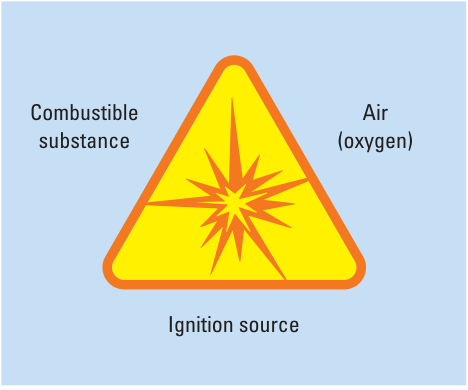
Vụ nổ (Explosion) là phản ứng hóa học đột ngột của một chất dễ cháy với oxy, dẫn đến sự giải phóng một lượng năng lượng rất lớn. Một vụ nổ chỉ có thể xảy ra khi có mặt đồng thời cả ba yếu tố (xem Hình 1):
- Chất dễ cháy (Combustible substance).
- Oxy / Không khí (Oxygen / air).
- Nguồn đánh lửa (Ignition source).
Chất dễ cháy (Combustible substance)
Các chất dễ cháy có thể tồn tại ở dạng khí (gases), sương mù (mists), hơi (vapours) hoặc bụi (dusts). Các thông số liên quan đến an toàn cần phải được xem xét để xác định đặc tính của các nguy cơ tiềm ẩn.
Môi trường khí quyển nổ (Explosive atmosphere)
Môi trường khí quyển nổ chứa hỗn hợp của không khí và các chất khí, hơi, sương mù hoặc bụi dễ cháy trong điều kiện khí quyển mà tại đó, sau khi bị đánh lửa, quá trình cháy sẽ lan truyền ra toàn bộ hỗn hợp chưa cháy. Nhìn chung, điều kiện khí quyển tiêu chuẩn được xác định là nhiệt độ môi trường từ -20 °C đến +60 °C, dải áp suất từ 0,8 bar đến 1,1 bar và hàm lượng oxy trong không khí là 21%.
Điểm chớp cháy (Flashpoint)
Điểm chớp cháy (Flashpoint) là nhiệt độ thấp nhất mà tại đó một chất lỏng dễ cháy tạo thành hỗn hợp có thể bắt lửa với không khí ngay phía trên bề mặt chất lỏng (trong điều kiện áp suất không khí bình thường). Nếu điểm chớp cháy của một chất lỏng dễ cháy cao hơn nhiều so với nhiệt độ tối đa có thể phát sinh trong thực tế, thì môi trường khí quyển nổ không thể hình thành. Tuy nhiên, điểm chớp cháy của một hỗn hợp gồm nhiều chất lỏng khác nhau có thể thấp hơn điểm chớp cháy của từng thành phần riêng lẻ. Trong Pháp lệnh về các chất nguy hiểm của Đức (Gefahrenstoffverordnung), bên cạnh nhiệt độ sôi (boiling point), điểm chớp cháy của chất lỏng được sử dụng để phân loại các chất lỏng dễ cháy (xem Bảng 1).
| Phân loại (Category) | Tiêu chí (Criteria) |
|---|---|
| 1 | Điểm chớp cháy (Flashpoint) < 23 °C và nhiệt độ sôi (boiling point) ≤ 35 °C |
| 2 | Điểm chớp cháy (Flashpoint) < 23 °C và nhiệt độ sôi (boiling point) > 35 °C |
| 3 | Điểm chớp cháy (Flashpoint) ≥ 23 °C và ≤ 60 °C (1) |
| (1) Theo Quy định CLP (CLP Regulation), dầu gas (gas oil), dầu diesel và nhiên liệu sưởi nhẹ có điểm chớp cháy từ 55 °C đến 75 °C có thể được xem là thuộc Phân loại 3 (Category 3). | |
Giới hạn nổ (Explosive limits – LEL & UEL)
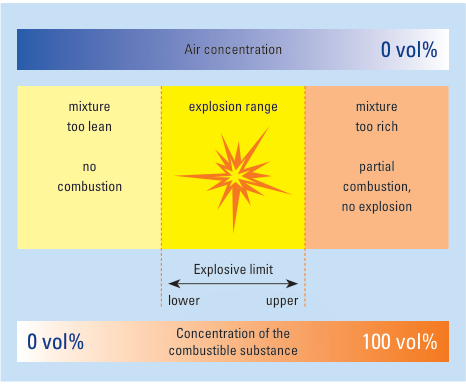
Để hình thành một môi trường khí quyển nổ, chất dễ cháy phải hiện diện ở một nồng độ nhất định (xem Hình 2). Trong trường hợp nồng độ không đủ (hỗn hợp quá nghèo – lean mixture) hoặc nồng độ quá cao (hỗn hợp quá giàu – rich mixture), sẽ không có vụ nổ nào xảy ra, mà chỉ có phản ứng cháy tĩnh tại hoặc không cháy. Chỉ trong khoảng nồng độ nằm giữa giới hạn nổ dưới (LEL – Lower Explosive Limit) và giới hạn nổ trên (UEL – Upper Explosive Limit) thì hỗn hợp mới phản ứng nổ khi bị kích cháy. Giới hạn nổ phụ thuộc vào áp suất môi trường và tỷ lệ phần trăm oxy trong không khí (xem Bảng 2).
| Tên chất (Designation of substances) | Giới hạn nổ dưới – LEL [% thể tích] | Giới hạn nổ trên – UEL [% thể tích] |
|---|---|---|
| Acetylene (Axetylen) | 2,3 | 100 (tự phân hủy / self-decomposing) |
| Ethylene (Etylen) | 2,4 | 32,6 |
| Petrol (Xăng) | ~0,6 | ~8,0 |
| Benzene (Benzen) | 1,2 | 8,0 |
| Fuel oil / diesel (Dầu nhiên liệu / Diesel) | ~0,6 | ~6,5 |
| Methane (Mêtan) | 4,4 | 17,0 |
| Propane (Propan) | 1,7 | 10,8 |
| Carbon disulphide (Cacbon đisunfua – CS₂) | 0,6 | 60,0 |
| Hydrogen (Hydro – H₂) | 4,0 | 77,0 |
| Trích từ bảng “Safety characteristics, Vol. 1: Combustible liquids and gases” của E. Brandes và W. Möller, K. Nabert và G. Schön (ấn bản lần thứ 6). | ||
Các nguồn đánh lửa (Ignition sources)
Để ngăn ngừa việc kích cháy một môi trường khí quyển nổ nguy hiểm, tất cả các nguồn đánh lửa tiềm ẩn phải được nhận diện và áp dụng biện pháp bảo vệ để vô hiệu hóa nguy cơ từ chúng. Sự đánh lửa của môi trường khí quyển nổ có thể bắt nguồn từ 13 nguồn sau đây:
- Bề mặt nóng (Hot surfaces)
- Ngọn lửa và khí nóng (Flames and hot gases)
- Tia lửa phát sinh do ma sát / va đập cơ học (Mechanically generated sparks)
- Hệ thống và thiết bị điện (Electrical systems)
- Dòng điện cân bằng (dòng rò), hệ thống chống ăn mòn catốt (Electrical equalising currents, cathodic corrosion protection)
- Tĩnh điện (Static electricity)
- Sét đánh (Lightning)
- Sóng điện từ tần số cao (Electromagnetic waves – high frequency)
- Bức xạ quang học (Optical radiation)
- Bức xạ ion hóa (Ionising radiation)
- Sóng siêu âm (Ultrasound)
- Nén đoạn nhiệt và sóng xung kích (Adiabatic compression and shock waves)
- Phản ứng hóa học tỏa nhiệt (Exothermal reactions)
Năng lượng đánh lửa tối thiểu (Minimum ignition energy)
Cần cung cấp một lượng năng lượng nhất định để có thể kích cháy một môi trường có nguy cơ nổ. Năng lượng đánh lửa tối thiểu (Minimum ignition energy – MIE) là thuật ngữ dùng để chỉ mức năng lượng nhỏ nhất – ví dụ khi phóng điện một tụ điện – vừa đủ để kích cháy hỗn hợp dễ cháy tương ứng. Năng lượng đánh lửa tối thiểu nằm trong khoảng 10-5 joules (10 µJ) đối với khí hydro và lên đến vài joules đối với một số loại bụi nhất định.
Phòng chống cháy nổ tích hợp (Integrated explosion protection)
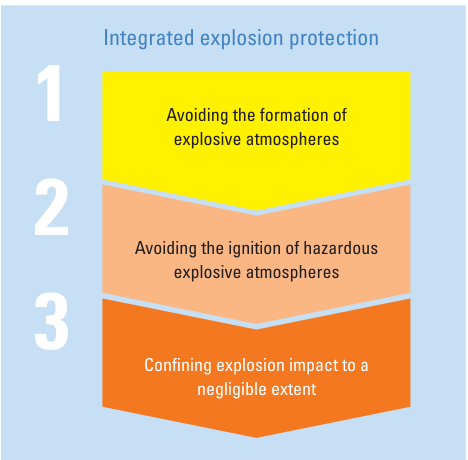
Nguyên tắc phòng chống cháy nổ tích hợp (integrated explosion protection) yêu cầu mọi biện pháp bảo vệ phòng nổ phải được thực hiện theo một trình tự ưu tiên cố định, phân biệt rõ giữa các biện pháp bảo vệ sơ cấp (primary), thứ cấp (secondary) và cấp ba / kết cấu (tertiary / constructional):
1. Phòng chống cháy nổ sơ cấp (Primary explosion protection)
Phòng nổ sơ cấp bao gồm tất cả các biện pháp ngăn ngừa sự hình thành của môi trường khí quyển nổ nguy hiểm – bởi vì phòng ngừa luôn tốt hơn bảo vệ. Do đó, các biện pháp phòng ngừa này luôn phải được thực hiện trước tiên. Có thể áp dụng các biện pháp sau:
- Tránh sử dụng các chất dễ cháy (thay thế bằng công nghệ/vật liệu khác).
- Trơ hóa môi trường – Inerting (bổ sung khí nitơ, carbon dioxide, v.v.).
- Giới hạn nồng độ chất cháy bằng thông gió tự nhiên hoặc thông gió cưỡng bức (nhân tạo).
2. Phòng chống cháy nổ thứ cấp (Secondary explosion protection)
Nếu nguy cơ cháy nổ không thể loại trừ hoàn toàn hoặc chỉ loại trừ được một phần bằng các biện pháp ngăn ngừa sự hình thành môi trường nổ, thì phải áp dụng các biện pháp ngăn chặn sự đánh lửa của môi trường khí quyển nổ (sử dụng thiết bị điện phòng nổ đạt chuẩn). Mức độ an toàn yêu cầu của các biện pháp này phụ thuộc vào mức độ nguy hiểm tiềm ẩn tại vị trí vận hành (Zone 0/20, Zone 1/21, Zone 2/22).
3. Phòng chống cháy nổ cấp ba hoặc theo kết cấu (Tertiary or constructional explosion protection)
Nếu sự xuất hiện của môi trường khí quyển nổ nguy hiểm không thể ngăn chặn một cách an toàn và khả năng đánh lửa không thể loại trừ, thì phải áp dụng các biện pháp giới hạn tác động của vụ nổ ở mức không đáng kể. Các biện pháp khả thi bao gồm:
- Thiết kế vỏ bọc chịu lửa (flameproof) hoặc chịu xung áp suất nổ (pressure-surge-resistant design).
- Thiết bị xả áp suất nổ (pressure relief) và bù áp suất (pressure compensation equipment).
- Hệ thống dập nổ bằng thiết bị chữa cháy chuyên dụng (explosion suppression with extinguishing devices).
Trọn bộ Chuyên đề Phòng Chống Cháy Nổ (R. STAHL – Tư vấn kỹ thuật NKE)
Chuỗi 6 bài viết bao gồm 1 bài tổng quan từ R. STAHL Blog và 5 phần chi tiết theo từng chương của cẩm nang Essential Explosion Protection:
- 01Nguyên Lý Cơ Bản Về Phòng Chống Cháy Nổ – Ngăn Chặn Vụ Nổ Trước Khi Bắt Đầu
- 02Cẩm Nang Phòng Chống Cháy Nổ (Phần 1): Nguyên Lý Vật Lý Và Các Định Nghĩa Cơ Bản
- 03Cẩm Nang Phòng Chống Cháy Nổ (Phần 2): Cơ Sở Pháp Lý Quốc Tế (IECEx), Châu Âu (ATEX) Và Bắc Mỹ (NEC/CEC)
- 04Cẩm Nang Phòng Chống Cháy Nổ (Phần 3): Nguyên Lý Kỹ Thuật – Phân Vùng Zone, Cấp Bảo Vệ EPL, Nhóm Nhiệt Độ, Các Kiểu Bảo Vệ Ex & Ký Hiệu Nhãn Thiết Bị
- 05Cẩm Nang Phòng Chống Cháy Nổ (Phần 4): Lắp Đặt, Vận Hành, Kiểm Tra Và Bảo Trì Thiết Bị Điện Trong Khu Vực Nguy Hiểm
- 06Cẩm Nang Phòng Chống Cháy Nổ (Phần 5 – Phụ Lục): Bảng Tra Cứu Đặc Tính Khí Cháy, Cấp Bảo Vệ Vỏ IP/NEMA & Sơ Đồ Giải Mã Nhãn Thiết Bị Ex
Foreword
In many industries, gases, vapours, mist and dust develop and escape in the course of manufacturing, processing, transporting and storing combustible substances. Explosive atmospheres may arise when they come into contact with oxygen, and if ignited, explosions occur that may result in catastrophic damage to human life and property.
Industries such as oil and gas, chemicals, petrochemicals, pharmaceuticals, fertilisers, food and beverages, biofuel and waste water are considered potential for explosions in general. Safety regulations to avoid explosions have been developed worldwide in the form of legislation, ordinances and standards. These standards ensure compliance to high safety standards.
This publication provides both professionals and others interested in this subject with an insight into the field of explosion protection. It contains the relevant international legal bases and norms, European directives and North American standards. Along with technical principles such as zone classification, temperature classes and protection types, the brochure supplies information on the installation and operation of equipment in hazardous areas. This document serves as the basics and does not replace relevant study of the current applicable regulations.
1. Physical Principles and Definitions
Explosion protection is a key area of safety engineering. So it is essential to understand the fundamental principles of an explosion and its causation factors. The first chapter of our brochure familiarises readers with the main principles and terms in the field of explosion protection.
An explosion is the sudden chemical reaction of a combustible substance with oxygen, resulting in the release of a high amount of energy. An explosion can only occur when three factors are present at the same time (see Fig. 1):
- Combustible substance.
- Oxygen (air).
- Ignition source.
Combustible substance
Combustible substances may be present in the form of gases, mists, vapours or dusts. Safety-relevant parameters need to be considered to characterise hazard potentials.
Explosive atmosphere
Explosive atmospheres contain a mixture of air and combustible gases, vapours, mists or dust in atmospheric conditions in which after ignition the combustion process spreads to the entire unburned mixture. In general, the atmospheric conditions are deemed to be ambient temperatures of -20 °C to +60 °C, a pressure range of 0.8 bar to 1.1 bar and an oxygen content of 21% in the air.
Flashpoint
The flashpoint is the minimum temperature at which a combustible liquid forms an ignitable mixture with air above the surface of the liquid (in normal air pressure conditions). If the flashpoint of a combustible liquid is far higher than the maximum temperatures which arise, an explosive atmosphere cannot be formed. However, the flashpoint of a mixture of various liquids may be lower than that of the individual components. In the German Ordinance on Hazardous Substances (Gefahrenstoffverordnung), besides its boiling point, the flashpoint of a liquid is used to classify liquids (see Table 1).
| Category | Criteria |
|---|---|
| 1 | Flashpoint < 23 °C and boiling point ≤ 35 °C |
| 2 | Flashpoint < 23 °C and boiling point > 35 °C |
| 3 | Flashpoint ≥ 23 °C and ≤ 60 °C (1) |
| (1) For the purpose of the CLP Regulation, gas oil, diesel and light heating fuels, which have a flashpoint ranging from 55 °C to 75 °C, may be deemed to belong to Category 3. | |
Explosive limits
To form an explosive atmosphere, the combustible substance must be present in a certain concentration (see Fig. 2). In the case of insufficient concentrations (lean mixture) or excessive concentrations (rich mixture) no explosion takes place, but a stationary or non-combustive reaction. It is only in the range between the lower (LEL) and upper (UEL) explosive limits that the mixture reacts explosively when ignited. The explosive limits depend on the ambient pressure and the percentage of oxygen in the air (see Table 2).
| Designation of substances | Lower explosive limit [vol. %] | Upper explosive limit [vol. %] |
|---|---|---|
| Acetylene | 2.3 | 100 (self-decomposing) |
| Ethylene | 2.4 | 32.6 |
| Petrol | ~0.6 | ~8.0 |
| Benzene | 1.2 | 8.0 |
| Fuel oil / diesel | ~0.6 | ~6.5 |
| Methane | 4.4 | 17.0 |
| Propane | 1.7 | 10.8 |
| Carbon disulphide | 0.6 | 60.0 |
| Hydrogen | 4.0 | 77.0 |
| Extract from the table “Safety characteristics, Vol. 1: Combustible liquids and gases” by E. Brandes and W. Möller, K. Nabert and G. Schön (6th edition). | ||
Ignition sources
In order to prevent ignition of a hazardous explosive atmosphere, all potential sources of ignitions must be identified and safeguarded to make them nonthreatening. Ignition of an explosive atmosphere may, for instance, be caused by the following sources:
- Hot surfaces
- Flames and hot gases
- Mechanically generated sparks
- Electrical systems
- Electrical equalising currents, cathodic corrosion protection
- Static electricity
- Lightning
- Electromagnetic waves (high frequency)
- Optical radiation
- Ionising radiation
- Ultrasound
- Adiabatic compression and shock waves
- Exothermal reactions
Minimum ignition energy
The supply of a specific amount of energy is required to ignite a potentially explosive atmosphere. Minimum ignition energy is the term applied to the minimum amount of energy, for instance when discharging a capacitor, which is just sufficient to ignite the respective combustible mixture. The minimum ignition energy is in the area of 10-5 joules for hydrogen and up to a few joules for certain dusts.
Integrated explosion protection
The principle of integrated explosion protection requires that all explosion protection measures be performed in a fixed order, with a distinction between primary, secondary and tertiary (constructional) protection measures.
Primary explosion protection
Primary explosion protection covers all measures that prevent the occurrence of a hazardous explosive atmosphere – for prevention is always better than protection. These precautions should therefore always be implemented first. The following protection measures can be adopted:
- avoidance of combustible substances (alternative technologies).
- inerting (addition of nitrogen, carbon dioxide, etc.).
- limiting of the concentration by means of natural or artificial ventilation.
Secondary explosion protection
If explosion hazards cannot be entirely or only partially excluded by measures to prevent the formation of explosive atmospheres, measures must be adopted to prevent the ignition of explosive atmospheres. The required safety level of these measures depends on the hazard potential at the operating location.
Tertiary or constructional explosion protection
If the occurrence of a hazardous explosive atmosphere cannot be safely prevented and its ignition cannot be excluded, measures must be adopted that limit the impact of an explosion to a negligible extent. The following precautions are possible:
- flameproof or pressure-surge-resistant design.
- pressure relief and pressure compensation equipment.
- explosion suppression with extinguishing devices.
Complete Explosion Protection Technical Series (R. STAHL Reference Guide)
All 6 articles covering the R. STAHL Blog overview and Chapters 1–5 of the Essential Explosion Protection brochure:
- 01Basic Principles of Explosion Protection – Stop a Big Bang Before It Starts
- 02Essential Explosion Protection (Part 1): Physical Principles and Definitions
- 03Essential Explosion Protection (Part 2): Legal Bases – Worldwide (IECEx), European Union (ATEX) & North America
- 04Essential Explosion Protection (Part 3): Technical Principles – Zone Classification, EPL, Equipment Groups, Temperature Classes, Protection Types & Marking
- 05Essential Explosion Protection (Part 4): Installation and Operation of Electrical Equipment in Hazardous Areas
- 06Essential Explosion Protection (Part 5 – Appendix): Safety Characteristics of Flammable Gases, IP / NEMA Enclosure Ratings & Ex Marking Tables
